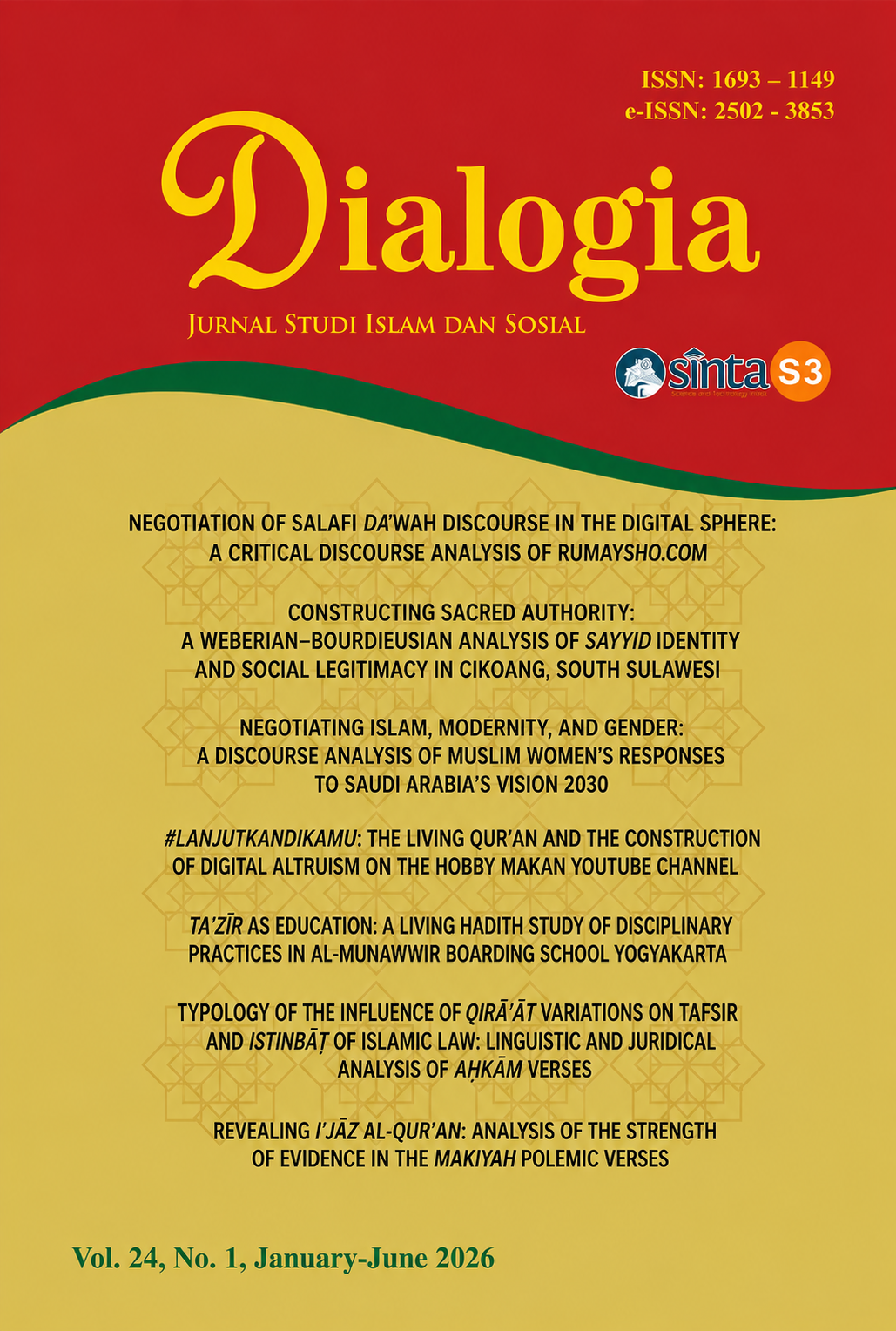
Revealing Iʿjāz al-Qur’an
Analysis of the Strength of Evidence in the Makiyah Polemic Verses
DOI:
https://doi.org/10.21154/dialogia.v24i01.13350Keywords:
I’jāz, Controversial Verses, New Religions, ProphethoodAbstract
Classical scholarship has predominantly located the i‘jāz al-Qur’an (the inimitability of the Qur’an) in its linguistic excellence, scientific allusions, and foreknowledge of the unseen. Such approaches, however, have paid limited attention to the Qur’an’s polemical discourse as a possible locus of i‘jāz. This article proposes an alternative perspective by examining the inimitability of the Qur’an through the argumentative and moral force embedded in its polemical verses. It addresses three questions: why i‘jāz appears within Qur’anic polemics, how these verses affected the Meccan audience, and in what ways the Qur’an’s argumentative structure functioned as a form of i‘jāz in the socio-historical context of Mecca. This study employs qualitative textual analysis based on primary sources consisting of Meccan surahs and selected sīrah literature, complemented by secondary scholarship from both Muslim and Orientalist traditions. The analysis is conducted through a contemporary interpretive framework integrating Muḥammad ‘Ābid al-Jābirī’s theory of Arab reason and Abu Hilal al-‘Askarī’s conception of i‘jāz. The study argues that the inimitability of the Qur’an cannot be reduced solely to aesthetic or epistemic dimensions but also resides in its capacity to construct compelling and irreducible arguments against the opponents of prophethood while simultaneously generating new forms of communal solidarity. The findings indicate that the Qur’an emerged within a context of socio-economic inequality and exercised transformative power by challenging established authority through a moral discourse grounded in values that were already recognized within the religious consciousness of Meccan society. This article contributes to contemporary Qur’anic studies by advancing a moral-argumentative model of i‘jāz, demonstrating that the Qur’an’s polemical discourse constitutes a distinct mode of Qur’anic inimitability.
Downloads
References
Al-Azraqi. Akhbār Al-Makkah. Maktabat al-Asadi, n.d.
Al-Baihaqi. Dalāil Al-Nubuwah. Volume 2. Mesir: Dar al-Rayyan wa Ma’rifati Shahibi al-Syarii’ah, T.Th.
Alhaji, Muritala, and Ishaq Adebayo. I‘jaz aL-Qur’an: ‘Abd al-Qahir al-Jurjani’s Theory of Naẓm. n.d.
Ali, Jawad. Al-Mufaṣṣal Fī Tārīkh al-‘Arab Qabla al-Islām. Volume 4. Baghdad: Jāmi’atu Baghdad, 1993.
———. Al-Mufaṣṣal Fī Tārīkh al-‘Arab Qabla al-Islām. Volume 5. Baghdad: Jami’atu Baghdad, 1993.
Al-Jabiri, Muhamad Abid. Madkhal Ila Al-Qur’an al-Karim: Fi Ta’rif al-Qur’an. Beirut: Markaz Dirasat al-Wahdat al-Arabiyah, 2006.
———. Naḥnu Wa Turāth: Qirā’āt Mu’āṣirat Fī Turāthunā al-Falsafī. Beirut: Markaz Dirasat al-Wahdat al-Arabiyah, 1993.
Al-Qurṭubi. Jāmi’u al-Aḥkām al-Qur’an. Volume 6. Kairo: Dār al-Kutub al-Miṣriyah, 1964.
———. Jāmi’u al-Aḥkām al-Qur’an. Volume 20. Kairo: Dār al-Kutub al-Miṣriyah., 1964.
Al-Ṭabari. Tarikh Al-Umam Wa al-Muluk. Volume 1. Beirut: Dar al-Kutub al-Ilmiyah., 1978.
Al-Ṭabari. Tārīkh Al-Umam Wa al-Mulūk. Volume 2. Beirut: Dār al-Kutub al-Ilmiyah., 1978.
Al-Ya’qubi. Tārīkh Al-Ya’qubi. Beirut: Dār al-Ṣadr, 1995.
Andrae, Tor. Mohammed The Man and His Faith. Vol. 1. London: Routledge Taylor & Francis Group, 1936.
Askari, Abū Hilāl al-’. Al-Furūq al-Lughawiyah. Beirut: Dar al-Kutub al-Ilmiyah, 2018.
Balādhurī. Ansāb Al-Ashrāf. Volume 1. Cairo: Dār al-Fikriah, 1959.
Becker, C. H. “C Hristian Polemic and the Form Ation of Islamic Dogma.” In Muslims and Others in Early Islamic Society, Robert Hoyland, Vol. 18. London: Routledge Taylor & Francis Group, 2017.
Bukharin, Michael. “‘Mecca on The Caravan Routes in Pre-Islamic Antiquity.’” In The Encyclopaedia of The Qur’an, vol. 4. London: Brill, 2001.
Edelby, Néophyte. “The Legislative Autonom y of C Hristians in the Islamic World.” In Muslims and Others in Early Islamic Society, Robert Hoyland, Vol. 18. London & New York: Routledge Taylor & Francis Group, 2017.
Friedmann, Yohanan. Tolerance and Coercion in Islam: Interfaith Relations in the Muslim Tradition. Cambridge: Cambridge University Press, 2003.
Goitein, S. D. “Minority Selfrule and G Overnm Ent Control in Islam.” In Muslims and Others in Early Islamic Society, Robert Hoyland, Vol. 18. London: Routledge Taylor & Francis Group, 2017.
Griffith, Sidney H. “C Om Parative Religion in the Apologetics of the F Irst C Hristian A Rabic Theologians.” In Muslims and Others in Early Islamic Society, Robert Hoyland, Vol. 18. Routledge Taylor & Francis Group, 2017.
Grunebaum, Gustav Von. The Section on Poetry Al-Baqillani: I’jaz al-Qur’an. Chicago: The University of Chicago Press, 1950.
Heck, Gene W. ““Arabia Without Spices: An Alternate Hypothesis.” Journal of The American Oriental Society, No. 3, vol. 123 (2003).
———. “”Gold Mining in Arabia and The Rise of The Islamic State”.” Journal of The Economic and Social History of The Orient, No. 3, Volume 42 (1999).
Hitty, Philip K. The History of The Arabs. London: The Macmillan Press, 1937.
Ibn Atsīr. Al-Kamil Fi al-Tarikh. Volume 2. Beirut: Dār al-Kutub al-Ilmiyah, 1978.
Ibn Ḥabīb. Al-Munammaq Fī Akhbār Quraish. Beirut: ‘Ālam al-Kutub, 1985.
Ibn Hisham. Al-Sīrah al-Nabawiyah. Ed. Umar Abd al-Salam al-Tadmuri. Volume 1. Beirut: Dār al-Kutub al-Miṣriyah, 1990.
———. Al-Sīrah al-Nabawiyah. Ed. Umar Abd al-Salam al-Tadmuri. Volume 2. Beirut: Dār al-Kutub al-Ilmiyah, 1990.
Ibn Sa’ad. Ṭabaqāt Al-Kubra. Volume 1. Beirut: Dār al-Kutub al-Ilmiyah., 2017.
Ibn Ṣadīq, Abū Hishām Abdullāh. Al-Usrat al-Qurashiyah A’yān Makata al-Maḥmiyah. Jiddah: Al-Mamlakah al-‘Arabiyah, 1983.
Ibrahim, Mahmood. “”Social and Economic Conditions in Pre-Islamic Mecca”.” International Journal of Midle East Studiest, No. 3, Volume 14 (1982).
Ikhwan, Munirul. “‘Drama Ilahi: Sebuah Upaya Dalam Membaca Kronologi Wahyu Alquran,.’” Mutawatir: Jurnal Keilmuan Tafsir Hadith, No. 2, Volume 10 (2020).
Jabiri, Muhammad Abid al-. Fahm Al-Qur’an al-Ḥakīm. Al-Tafsīr al-Waḍiḥ Ḥasba Tartīb al-Nuzūl. Volume 1. Maghrib: Dār al-Baiḍla’., 2009.
Khel, Muhammad Nazer Ka Ka. “”Political System in Pre-Islamic Arabia”.” Islam Studies., N0. 4, Volume 20 (1981).
Kister, M. J. ““Do Not Assimilate Yourselves . . La Tashabbahü.” In Muslims and Others in Early Islamic Society, Robert Hoyland, Vol. 18. London: Routledge Taylor & Francis Group, 2017.
Koertner, Mareike. Proving Prophecy Dalāʾil Al-Nubūwa Literature as Part of the Scholarly Discourse on Prophecy in Islam. London: Brill, 2024.
M, Maraqten. “”Wine Drinking and Wine Prohibition in Arabia Befor Islam”.” Proceding of The Seminar For Arabian Studies Held at Manchester on 1992 Volume 23 (1993).
M.J, Kister. “”Mecca and Tamīm (Aspects of Their Relations)”.” Journal of The Economic and Social History of The Orient, No. 3, Volume 20 (1977).
Mūsā., Qāḍī ʿIyād b. Al-Shifāʾ Bi-Taʿrīf Ḥuqūq al-Muṣṭafāʾ. Alī Muḥammad al-Bajāwī (ed). Vol. 2. Cairo: T.P, 1977.
Pinker, Steven. “The Evolusionary Psycology of Religion.” In WHere God and Science Meet: How Brain and Evolutionary Studies Alter Our Understanding of Religion, Patrick McNamara (ed), Volume 1. United State of America: An imprint of Greenwood Publishing Group, Inc., 2006.
Potts, Daniel T. “”Trans Arabian Routes of The Pre Islamic Period.” In The Arabs and Arabia on The Eve of Islam, Ed. F.E Peters, Volume 3. London: Routledge, n.d.
Qarnas, Ibn. Ahsan Al-Qashash: Tarikh al-Islam Kama Warada Mina al-Mashdar Ma’a Tartib as-Sur Hasba an-Nuzul. German: Al-Kamel Verlag, 2010.
Qian, Ailin. “Spice, Spiced, Wine and Pure Wine.” No. 2, Volume 128 (2008).
Rahman, Yusuf. “The Miraculous Nature of Muslim Scriture : A Study of ’Abd al-Jabbar’s I’jaz al-Qur’an.” Islamic Studies 35, no. 4 (1996): 409–24.
Rodinson, Maxime. Islam and Capitalisme. New York: Pantheon Book, 1966.
Sa’ad, Ibn. Tabaqat Al-Kubra. Volume 2. Beirut: Dar al-Kutub al-Ilmiyah, 2017.
———. Ṭabaqāt Al-Kubrā. Volume 5. Beirut: Dar al-Kutub al-Ilmiyah, 2017.
———. Ṭabaqāt Al-Kubrā. Volume 8. Dar al-Kutub al-Ilmiyah, 2017.
Shaban, M. A. Islamic History: A New Interpretation 600-750 A.D. Cambridge: Cambridge University Press, 1971.
Shahid, Irfan. “‘Exploring Trade Practice and Market Before and After The Advent of Islam in Arabia’.” Journal Journal of Emerging Economies & Islamic Research, No. 2, Volume 6 (2018).
———. “‘Ukaẓ.’” In The Encyclopaedia of Islam, Ed. PJ. Bearman, Th. Bianquis, C. E. Bosworth, E. Van Donzel and W. P. Heinrighs. Leiden: Brill, 2000.
Shahrur, Muḥammad. Al-Kitāb Wa al-Qur’ān: Qirā’ah Mu’āṣirah. Beirut: Shirkat al-Maṭbū’āh li al-Tawzī’ wa al-Nashr, 2000.
Shihab, Quraish. Mukjizat Al-Qur’an Ditinjau Dari Aspek Kebahasaan, Isyarat Ilmiah, Dan Pemberitaan Gaib. Jakarta: Mizan, 2006.
Sirry, Mun’im. Polemik Kitab Suci: Tafsir Reformasi Atas Kritik al-Qur’an Terhadap Agama Lain. Jakarta: Gramedia Pustaka Utama, 2012.
Smith, W. Robertson. Kinship and Marriage in Early Arabia. London: Adam and Charles Black, 1907.
Waardenburg, Jacques. “Muslim Studies of O Ther Religions: T He Medieval Period.” In Muslims and Others in Early Islamic Society, Robert Hoyland, Vol. 18. London: Routledge Taylor & Francis Group, 2017.
Watt, Montgomery. Islamic Philosophy and Theology: An Extended Survey. Edinburgh: Edinburgh University Press, 1992.
Watt, Montgomery. Muhammad at Mecca. Oxford: Calendron Press, 1960.
Wensinck, A. J. The Muslim Creed: Its Genesis and Historical Development (Cambridge: Cambridge University Press, 1932), p. 224. Cambridge: Cambridge University Press, 1932.
Downloads
Published
Issue
Section
License
Copyright (c) 2026 Ahmad Lutfi

This work is licensed under a Creative Commons Attribution-NonCommercial-ShareAlike 4.0 International License.
Dialogia : Jurnal Studi Islam dan Sosial allow the author(s) to hold the copyright without restrictions and allow the author(s) to retain publishing rights without restrictions, also the owner of the commercial rights to the article is the author.