
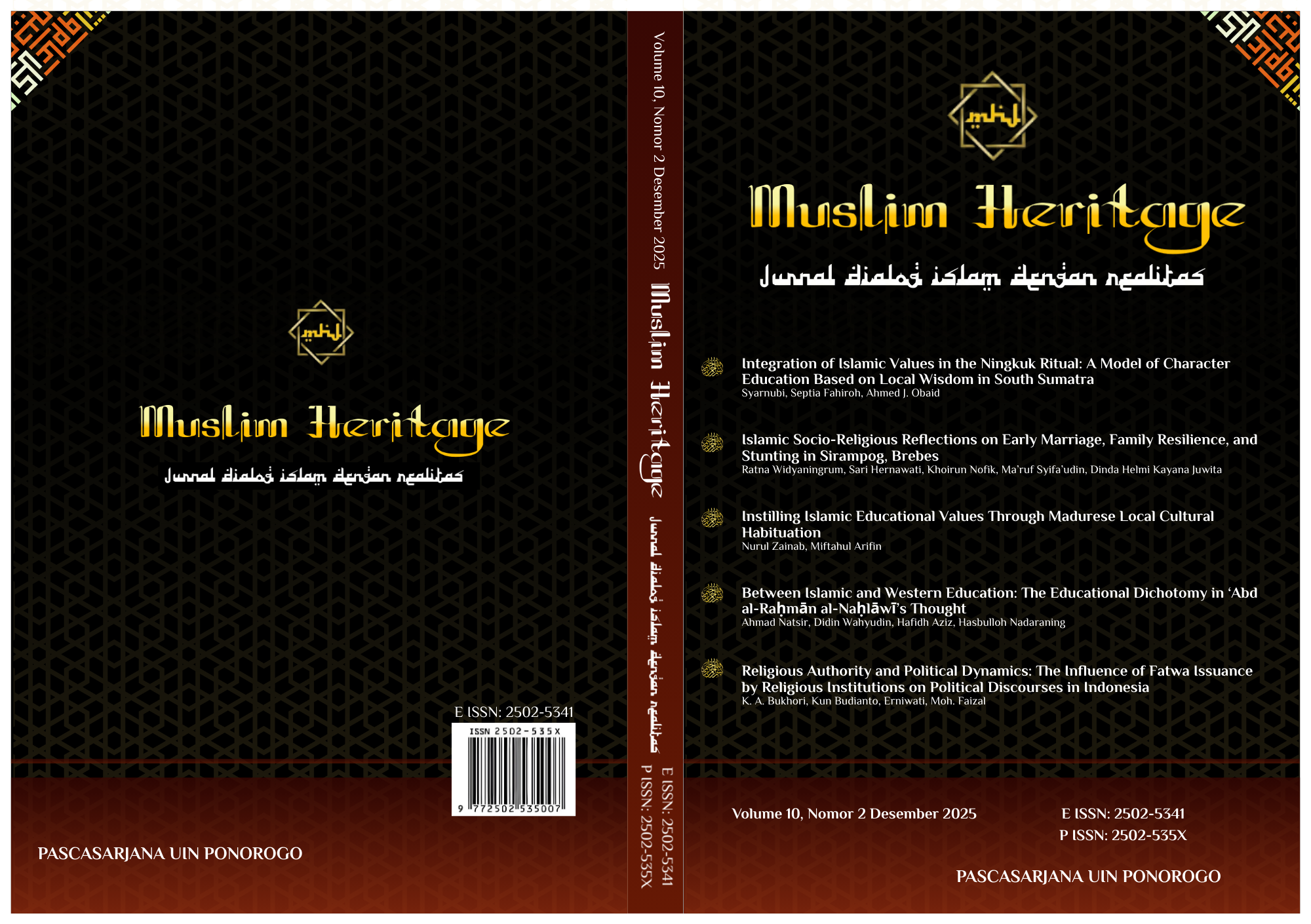
Religious Authority and Political Dynamics: The Influence of Fatwa Issuance by Religious Institutions on Political Discourses in Indonesia
DOI:
https://doi.org/10.21154/muslimheritage.v10i2.11784Keywords:
Dinamika Politik; Fatwa; Otoritas Keagamaan;Religious PoliticsAbstract
This study explores the role of religious institutions through fatwas in the formation of public policy in Indonesia, particularly major institutions such as the Indonesian Ulema Council (MUI), Nahdlatul Ulama (NU), and Muhammadiyah. The main objective is to understand how fatwas are produced by religious organizations and how they impact the political process and government policy. The research problem stems from the phenomenon that fatwas, although they do not have formal legal force, are often used as moral references by the community and are even considered by the government in formulating public policy. The research approach uses qualitative field studies: interviews with fatwa figures, analysis of fatwa documents, and observation of the interaction between religious institutions and public officials in several regions. The findings show that fatwas serve as moral and social legitimacy as well as non-formal influence on the formulation of public policy. Although not legally binding, the influence of fatwas on policy guidance is quite significant, especially on moral and social issues, as well as the creation of a space for dialogue between the state and society. The implications of the research results show the importance of understanding the role of fatwas not only as religious products but also as social political instruments in the architecture of public policy.
Abstrak
Penelitian ini mengeksplorasi peran lembaga keagamaan melalui fatwa dalam pembentukan kebijakan publik di Indonesia, khususnya lembaga-lembaga utama seperti Majelis Ulama Indonesia (MUI), Nahdlatul Ulama (NU), dan Muhammadiyah. Tujuan utama adalah memahami bagaimana fatwa diproduksi oleh organisasi keagamaan dan bagaimana dampaknya terhadap proses politis dan kebijakan pemerintah. Masalah penelitian berangkat dari fenomena bahwa fatwa, meskipun tidak memiliki kekuatan hukum formal, sering dijadikan rujukan moral oleh masyarakat dan bahkan dipertimbangkan pemerintah dalam merumuskan kebijakan publik. Pendekatan penelitian menggunakan studi lapangan kualitatif: wawancara dengan tokoh fatwa, analisis dokumen fatwa, dan observasi interaksi lembaga keagamaan dengan pejabat publik di beberapa daerah. Temuan menunjukkan bahwa fatwa berfungsi sebagai legitimasi moral dan sosial sekaligus pengaruh nonformal terhadap perumusan kebijakan publik. Meskipun tidak bersifat mengikat secara hukum, pengaruh fatwa terhadap panduan kebijakan cukup signifikan, terutama dalam isu moral dan sosial, serta penciptaan ruang dialog antara negara dan masyarakat. Implikasi hasil penelitian menunjukkan pentingnya memahami peran fatwa bukan hanya sebagai produk keagamaan, tetapi juga sebagai instrumen politik sosial dalam arsitektur kebijakan publik.
References
Aji, Aniko, Jefik Zulfikar Hafizd, and Am'mar Abdullah Arfan. "The Role of Administrative Courts in the Perspective of Fiqh Siyasah to Realize Good Governance." Hutanasyah: Journal of Constitutional Law 3, no. 2 (2025): 2. https://doi.org/10.37092/hutanasyah.v3i2.1075.
Amrin, Amrin, Suciyani Suciyani, and Nurrahmaniah Nurrahmaniah. “Reconstruction of Ali Yafie’s Thinking in the Field of Social Fiqh in the Development of Islamic Law (Critical Review).” AL-MANHAJ: Journal of Islamic Law and Social Institutions 5, no. 1 (2023): 1. https://doi.org/10.37680/almanhaj.v5i1.2341.
Andi Sani Silwana, Kurniati, and Abd. Rahman R. “The Role of Fatwa in the Formation of Legislation in Indonesia.” Al-Ubudiyah: Journal of Islamic Education and Studies 4, no. 1 (2023): 104–10. https://doi.org/10.55623/au.v4i1.177.
Andriansyah, Yuli. “Analysis of Fatwas by the National Sharia Board-Indonesian Council of Ulama on the Stock Market.” Millah: Journal of Religious Studies, August 30, 2023, 525–52. https://doi.org/10.20885/millah.vol22.iss2.art9.
Aniko Aji. “The Role of Administrative Courts in Creating Good Governance from the Perspective of Fiqh Siyasah (Case Study of the Semarang Administrative Court).” Diploma, S1-Islamic Constitutional Law UIN SSC, 2024. https://syekhnurjati.ac.id.
Arifin, Zainal, Tutik Hamidah, Zaenul Mahmudi, and Abd Rouf. “Analysis of Maqasidiyyah on The Compilation of Islamic Law and The Egyptian Al-Wasiyah Law Regarding Wajibah Bequest From Ibn Ashur’s Perspective.” Muslim Heritage 10, no. 1 (2025): 1. https://doi.org/10.21154/muslimheritage.v10i1.10733.
Asma, Siti Nor. “The Position of Fiqih Siyasah in Islamic Law.” Lex Sharia Pacta Sunt Servanda: Journal of Islamic Law and Policy 1, no. 2 (n.d.). https://journal.alshobar.or.id/index.php/lespass/article/view/269.
Aswar, Hasbi. “Secular Perspective on The Islamic Political Discourses in Indonesia: A Critical Analysis.” Journal of Islamic Civilization Studies 4, no. 2 (2021): 35–41. https://doi.org/10.47076/jkpis.v4i2.64.
Azani, Muhammad. “The Development of Islamic Law in Indonesia Through Traditional Theory and Legal Changes.” Jurnal Mahkamah: Kajian Ilmu Hukum Dan Hukum Islam 6, no. 2 (2021): 113–28. https://doi.org/10.25217/jm.v6i2.1626.
Azhar, Alias, Muhammad Azam Hussain, Mohd Zakhiri Md Nor, and Mohamad Khairi Othman. “Fatawa Research in the Framework of the Maqasid al-Sharia: An Overview.” Ulum Islamiyyah 20 (March 2017): 47–65. https://doi.org/10.33102/uij.vol20no0.40.
Charfi, N., A. Chamseddine, S. Omri, et al. “Epidemiological, Clinical, and Criminological Profile of Sex Offenders: Regarding the Study of a Tunisian Expert Series.” Archives of Legal Medicine 16, no. 2 (2025): 200528. https://doi.org/10.1016/j.aolm.2024.200528.
Chisum, W. Jerry. “Appendix II - Bloodstain Pattern Case Study.” In Crime Reconstruction (Second Edition), edited by W. Jerry Chisum and Brent E. Turvey. Academic Press, 2011. https://doi.org/10.1016/B978-0-12-386460-4.00025-4.
Department, Abdullah M. Al-Ansi$Social and Political Science, UMM, Malang, et al. “Rational Choice of Following Muhammadiyah and Nahdlatul Ulama and Their Social and Political Role in Indonesian Society.” Open Access Library Journal 06, no. 11 (2019): 1. https://doi.org/10.4236/oalib.1105829.
Fikri, Muhammad Farhan, Zurkarnen Zurkarnen, and Nurliana` Damanik. “The Islamic Political Thought of M. Quraish Shihab in Indonesia: An Analysis.” Islam & Contemporary Issues 4, no. 1 (2024): 1. https://doi.org/10.57251/ici.v4i1.1289.
Fikriana, Askana, and M. Kahfi Rezki. “Political Ethics and Qualifications of Legislative Candidates in Elections: A Fiqh Siyasah Perspective.” ALADALAH: Journal of Politics, Social Sciences, Law, and Humanities 2, no. 1 (2024): 235–48. https://doi.org/10.59246/aladalah.v2i1.657.
Ghaemi Asl, Mahdi. “An AI-Optimized Strategy for Intelligent Risk Mapping of Islamic and Conventional Sustainable Markets: Assessing the Enduring Dynamics of Technological Risk Spillovers.” Expert Systems with Applications 296 (January 2025): 128945. https://doi.org/10.1016/j.eswa.2025.128945.
Haddad, Achraf, and Mohamed Naceur Souissi. “The Impact of Shariah Advisory Board Characteristics on the Financial Performance of Islamic Banks.” Cogent Economics & Finance, Cogent, December 31, 2022. world. https://www.tandfonline.com/doi/abs/10.1080/23322039.2022.2062911.
Hasanudin, Hasanudin, Jaih Mubarok, and Muhammad Al-Fayyad Maulana. “Progressiveness of Islamic Economic Law in Indonesia: The Murā‘at Al-‘Ilal Wa Al-Maṣāliḥ Approach.”Samarah: Jurnal Hukum Keluarga Dan Hukum Islam 7, no. 2 (2023): 1267–92. https://doi.org/10.22373/sjhk.v7i2.17601.
Hosaini, and Muhammad Ihyaul Fikro. “The Indonesian State from an Islamic Perspective: As a Form of Strengthening Nationalism.” Moderasi : Journal of Islamic Studies 1, no. 2 (2021): 2. https://doi.org/10.54471/moderasi.v1i2.12.
Huang, Heye, Zheng Li, Hao Cheng, et al. “Understanding Driver Cognition and Decision-Making Behaviors in High-Risk Scenarios: A Drift Diffusion Perspective.” Accident Analysis & Prevention 220 (September 2025): 108123. https://doi.org/10.1016/j.aap.2025.108123.
Ipandang, Ipandang. “UNDERSTANDING THE MEANING OF GOD’S LEGISLATION: Critical Analysis of Islamic Law Reasoning Criticism in Indonesia.” Jurisdictie: Jurnal Hukum Dan Syariah 11, no. 2 (2020): 2. https://doi.org/10.18860/j.v11i2.9913.
Izmuddin, Iiz, Euis Amalia, Mohamad Abdun Nasir, and Farid Muttaqin. “The Legitimation of Religion in Profit Seeking: The Role of National Shari‘āh Division of The Indonesian Muslim Council (DSN-MUI).” Samarah: Journal of Family Law and Islamic Law 7, no. 2 (2023): 781–800. https://doi.org/10.22373/sjhk.v7i2.15835.
Kamsi, Kamsi. “THE IMAGE OF ISLAMIC POLITICAL MOVEMENTS IN THE HISTORY OF INDONESIAN POLITICS (A Study of the Pre-Independence Era to the New Order Era).” Millah: Journal of Religious Studies 13, no. 1 (2021): 109–54. https://doi.org/10.20885/millah.vol12.iss3.art6
Kappeler, Victor E., and Larry K. Gaines. “Chapter 1 - The Idea of Community Policing.” In Community Policing (Fifth Edition), edited by Victor E. Kappeler and Larry K. Gaines. Anderson Publishing, Ltd., 2009. https://doi.org/10.1016/B978-1-59345-511-8.50005-9.
Karimullah, Suud Sarim. “Religion and State in the Islamic Political Paradigm in Indonesia Perspective of Prof. Kamsi.” Analisis: Jurnal Studi Keislaman 22, no. 1 (2022): 53–74. https://doi.org/10.24042/ajsk.v22i1.12648.
Khatimah, Khusnul, Jamilah Jamilah, Atiqah Amalya Azzahra, Diva Fitaloka Otaviani, and Surya Sukti. “The Pancasila State in the Perspective of Fikih Siyasah.” Innovative: Journal of Social Science Research 4, no. 3 (2024): 3. https://doi.org/10.31004/innovative.v4i3.11501.
Li, Lin. “Chapter 1 - Democracy and the Rule of Law in Contemporary China.” In Building the Rule of Law in China, edited by Lin Li. Elsevier, 2017. https://doi.org/10.1016/B978-0-12-811930-3.00001-5.
Mappasessu Mappasessu. “Analysis of the Theory of the Enactment of Islamic Law: Implications and Challenges in Indonesia.” JHK: Journal of Law and Justice 1, no. 4 (n.d.). https://doi.org/10.61942/jhk.v1i4.175.
Mas’udi, Moh. “Muhammadiyah and Nahdlatul Ulama Contribution to The Islamic Economics Development in Indonesia.” Afkaruna: Indonesian Interdisciplinary Journal of Islamic Studies 19, no. 1 (2023): 109–22. https://doi.org/10.18196/afkaruna.v19i1.17820.
Mudzhar, M. Atho. “The Study of Sharia Sciences in Higher Education: Has it Responded to the Demands of Society?” Asy-Syir’ah: Journal of Sharia and Law 46, no. 2 (2012): 2. https://doi.org/10.14421/ajish.v46i2.43.
Mu’iz, Dzikrul Hakim Tafuzi, Nasrulloh Nasrulloh, Pepy Marwinata, and Mursyidatul Mahsunah. “The Relationship Between Religion, Politics, and the State in Indonesia: A Comparative Study of Soekarno and Abdurrahman Wahid.” Abdurrauf Journal of Islamic Studies 3, no. 3 (2024): 3. https://doi.org/10.58824/arjis.v3i3.174.
Muta’allim. “Kh. Hasyim Muzadi’s Language Politeness Strategies in Responding to the Different Perspectives Between Nahdlatul Ulama and Muhammadiyah: A Sociopragmatic Study.” Muslim Heritage 10, no. 1 (2025): 1. https://doi.org/10.21154/muslimheritage.v10i1.10951.
Najib, Agus Moh. “The Methodology of Indonesian Madhhab Ijtihad: Tracing the Thoughts of Hazairin on Usul al-Fiqh.” Asy-Syir’ah: Journal of Sharia and Law 50, no. 1 (2021): 1. https://doi.org/10.14421/ajish.v50i1.162.
Nasution, Faiz Albar. “Implications of Religious Fatwa on the Implementation of the COVID-19 Policy in Indonesia.” Pharos Journal of Theology, no. 104(3) (June 2023). https://doi.org/10.46222/pharosjot.104.320.
Nurdin, Ahmad Ali. “Revisiting Discourse on Islam and State Relation in Indonesia: The View of Soekarno, Natsir and Nurcholish Madjid.” Indonesian Journal of Islam and Muslim Societies 6, no. 1 (2023): 1. https://doi.org/10.18326/ijims.v6i1.63-92.
Pangestuti, Diah Sari. “The Role of Police Institutions in the Perspective of Fiqh Siyasah.” Al-Qanun: Journal of Islamic Legal Thought and Reform 22, no. 2 (2019): 2. https://doi.org/10.15642/alqanun.2019.22.2.401-423.
Qodir, Zuly, and Bilveer Singh. “The Contestation of Contemporary Islam: Conservative Islam versus Progressive Islam.” ESENSIA: Journal of Ushuluddin Sciences 23, no. 2 (2022): 2. https://doi.org/10.14421/esensia.v23i2.4316.
Rahman, Rahman, Efendi Sugianto, Wasalmi Wasalmi, Muhammad Asriady, and Ahmad Fauzi. “Hadith Interpretation of Law and Justice and Its Implementation as an Alternative Solution Rule of Law Enforcement In Indonesian.” Muslim Heritage 8, no. 2 (2023): 2. https://doi.org/10.21154/muslimheritage.v8i2.7214.
Rasyid, Muhammad, Akh Fauzi Aseri, Sukarni Sukarni, and Muhsin Aseri. “Scientific Consideration in the Concept of Islamic Law in Indonesia: A Study on The Fatwas of Falakiyah Of MUI.” Al-Daulah: Jurnal Hukum Dan Perundangan Islam 13, no. 2 (2023): 2. https://doi.org/10.15642/ad.2023.13.2.202-229.
Rezki, Sri, and Amril M. “The Transformation of Islamic State Administration: A Historical Analysis of Umar Bin Khattab’s Political Ijtihad.” Takuana: Journal of Education, Science, and Humanities 4, no. 1 (2025): 68–81. https://doi.org/10.56113/takuana.v4i1.127
Robin, Joey. “The Right to Refuse Medical Treatment Invoked by a Person Suffering from Mental Influence.” Law, Ethics & Care 21, no. 4 (2021): 532–39. https://doi.org/10.1016/j.ddes.2021.10.019.
Rofii, Ahmad. “Constitutional Limits of Islamic Law: God in the Preamble to the Indonesian Constitution.” Journal of Law, Religion and State 5, no. 2 (2023). https://doi.org/10.1163/22124810-11010001.
Safudin, Endrik, and Sesario Aulia. “Maslahah Mursalah in Ultra Petita Decision of The Constitutional Court.” Muslim Heritage 10, no. 1 (2025): 1. https://doi.org/10.21154/muslimheritage.v10i1.10764.
Saputera, Abdur Rahman Adi. “The Contribution of the Gorontalo Provincial MUI to the Welfare of the People During the Covid-19 Pandemic.” Tamaddun Journal of Islamic Studies 1, no. 1 (2022): 1. https://doi.org/10.55657/tajis.v1i1.26.
Sholichuddin, Muhamad Afrizal, Nicky Estu Putu Muchtar, and Rizky Dwi Ratna. “The Relationship of Islam and The State in Contemporary Islamic Political Discourse in Indonesia.” Dirasah International Journal of Islamic Studies 1, no. 2 (2023): 2. https://doi.org/10.59373/drs.v1i2.11.
Siino, Marco. “Exploring the Use of LLMs in the Italian Legal Domain: A Survey on Recent Applications.” Computer Law & Security Review 58 (September 2025): 106164. https://doi.org/10.1016/j.clsr.2025.106164.
Joint Ministerial Decree No. 3 of 2008 – Ahmadiyah Movement. n.d. Accessed August 6, 2025. https://ahmadiyah.org/skb-3-menteri-tentang-ahmadiyah/.
Sugara, Robi, and Maria Ulfa. “Implementation of Public Policy in Handling Covid-19 through a Religious Approach.” Jurnal Bimas Islam 14, no. 1 (2021): 1. https://doi.org/10.37302/jbi.v14i1.361.
Suhendar, Heris, Oyo Sunaryo Mukhlas, and Atang Abd Hakim. “Legal Politics of the Existence of Fatwa in Islamic Financial Institutions: Evidence from Indonesia.” Jurnal Hukum Islam 21, no. 2 (2023): 279–308. https://doi.org/10.28918/jhi_v21i2_03.
Sumarna, Elan. “Islamic Sharia in the Context of Social, Political, and Cultural Change.” Sosio Religi: Journal of General Education Studies 14, no. 2 (2023): 2. https://doi.org/10.17509/sosioreligi.v14i2.5611.
Suminto, Ahmad, Ahmad Agus Hidayat, Risma Nada Azkiya, Muhammad Alfan Rumasukun, and Rizki Ari Purnama. “Comparative Analysis of The Influence of Sharia and Conventional Monetary Instruments on The Real Sector: An Empirical Study of Indonesia’s IPI.” Muslim Heritage 9, no. 2 (2024): 2. https://doi.org/10.21154/muslimheritage.v9i2.8892.
Syarif, Nurrohman, Zulbaidah, and Muhammad Andi Septiadi. “Political Theology: How God’s Law Is Applied in the Context of Indonesian Democracy Based on Pancasila.” Cogent Arts & Humanities 11, no. 1 (2024): 2407104. https://doi.org/10.1080/23311983.2024.2407104.
“The Language of Exclusion: Ideology and Power in the Fatwa of the Indonesian Ulema Council on Ahmadiyah.” Journal of Islamic Law, ahead of print, August 10, 2025. https://doi.org/10.24260/jil.v6i1.3338.
Wahid, Soleh Hasan, Anjar Kususiyanah, and Fuady Abdullah. “Strengthening the Trust and Authority of Fatwa Institutions in the Digital Era: Lessons from Indonesia.” Journal of College of Sharia and Islamic Studies 43, no. 2 (2025). https://doi.org/10.29117/jcsis.2025.0425.
Yahya, Imam, and Sulistiyono Susilo. “Conservative Muslims in Indonesia’s Religious and Political Landscapes: Ahok’s Blasphemy Case as a Political Leverage.” Cogent Social Sciences, Cogent, December 31, 2024. world. https://www.tandfonline.com/doi/abs/10.1080/23311886.2024.2392293.
Yani, Muhammad Turhan, Choirul Mahfud, S.A.P. Rangga Sa’adillah, Mohammad Reevany Bustami, Maskuri, and Ahmad Taufiq. “Advancing the Discourse of Muslim Politics in Indonesia: A Study on Political Orientation of Kiai as Religious Elites in Nahdlatul Ulama.” Heliyon 8, no. 12 (2022): e12218. https://doi.org/10.1016/j.heliyon.2022.e12218.
Zulfikar, Zulfikar. “The Concept of Islamic Law Thought Of Sayyid Sabiq In The Book Of Fiqh Sunnah (Analytical Study In Distinguishing Bidh’ah And Ikhtilaf).” Al-Mashlahah Jurnal Hukum Islam Dan Pranata Sosial 8, no. 01 (2020): 01. https://doi.org/10.30868/am.v8i01.2548.
Downloads
Published
Issue
Section
License
Copyright (c) 2025 K.A. Bukhori, Kun Budianto, Erniwati, Moh. Faizal

This work is licensed under a Creative Commons Attribution-NonCommercial 4.0 International License.
Requirements to be met by the author as follows:
- Author storing copyright and grant the journal right of first publication manuscripts simultaneously with licensed under the Creative Commons Attribution License that allows others to share the work with a statement of the work's authorship and initial publication in this journal.
- Authors can enter into the preparation of additional contractual separately for non-exclusive distribution of a rich version of the journal issue (eg:post it to an institutional repository or publish it in a book), with the recognition of initial publication in this journal.
- Authors are allowed and encouraged to post their work online (eg, in institutional repositories or on their website) prior to and during the submission process, because it can lead to productive exchanges, as well as citations earlier and more severe than published works. (see The Effect of Open Access).