
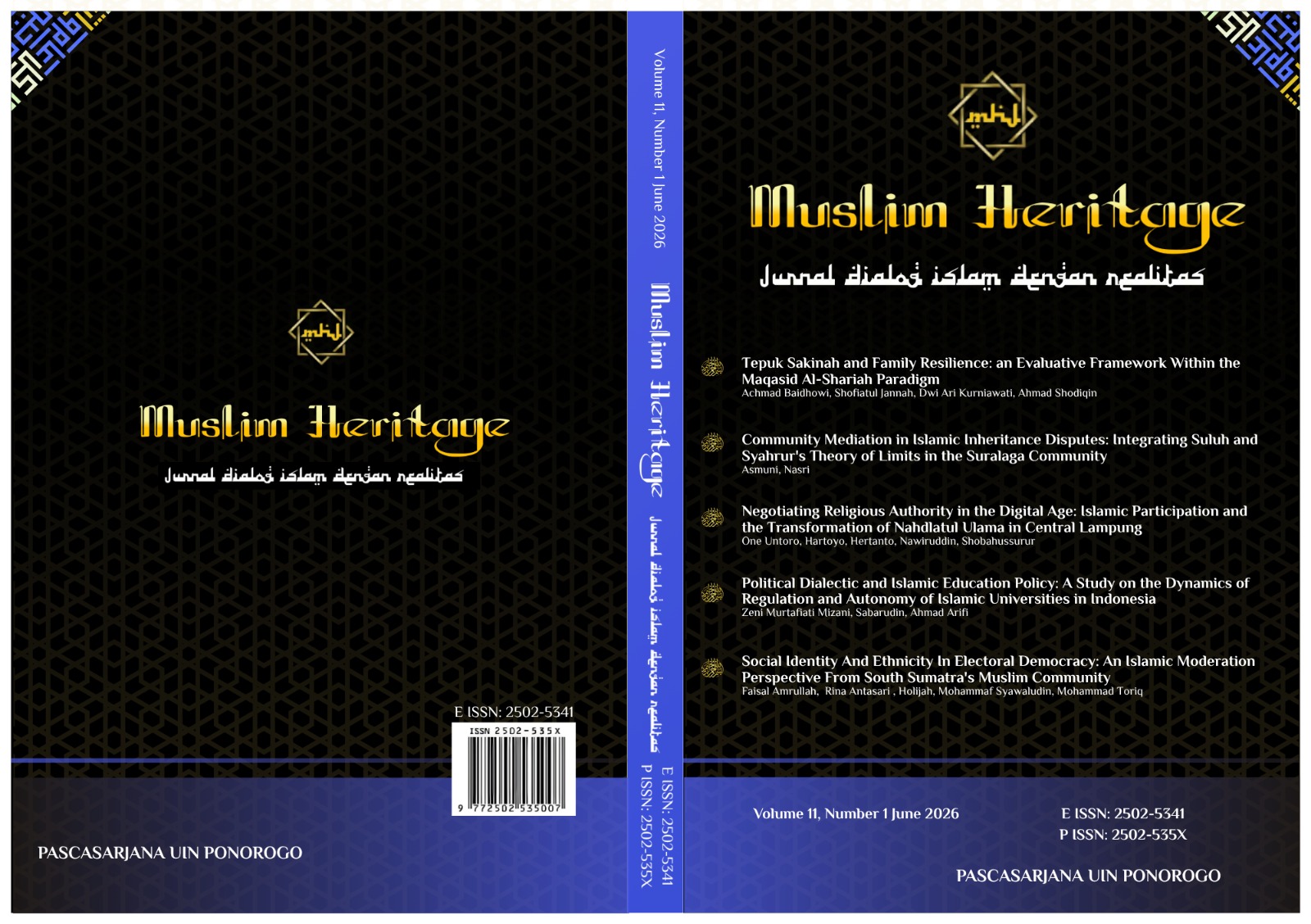
Community Mediation in Islamic Inheritance Disputes: Integrating Sulh and Syahrur's Theory of Limits in The Suralaga Community
DOI:
https://doi.org/10.21154/muslimheritage.v11i1.12364Keywords:
ṣuluḥ, inheritance dispute, community-based mediation, theory of limits, Muhammad SyahrurAbstract
The distribution of inheritance is one of the key aspects of Islamic family law that frequently gives rise to disputes. Consequently, this study aims to identify an integrative model for dispute resolution through community mediation, drawing on Muhammad Syahrur’s theory of limits. The study employs a normative empirical method with a socio legal approach that combines the study of Islamic law, customary law, and empirical data. Data was obtained through interviews with customary leaders, religious leaders, and mediators. The results of the study indicate that community mediation through the sulh mechanism integrates Islamic values, customary law, and state law. In this process, religious and customary leaders act as mediators who promote peace, justice, and agreement among the parties. Based on Muhammad Syahrur’s theory of limits, this allows for flexibility in determining inheritance shares, taking into account minimum and maximum limits in accordance with the socio-cultural context of the community without contravening the principles of Sharia. The integration of Islamic norms, the theory of limits, and the practice of sulh produces a restorative, participatory, and contextual model of dispute resolution, gaining both socio cultural legitimacy and legal legitimacy through formal legal recognition. Thus, this integrative model is not only an effective alternative for dispute resolution but also a new paradigm for achieving fair inheritance dispute resolution through the synergy between religion, custom, and state law.
Abstrak
Pembagian harta waris merupakan salah satu aspek penting dalam hukum keluarga Islam yang kerap menimbulkan sengketa. Untuk itu penelitian ini bertujuan menemukan model integratif penyelesaian sengketa melalui mediasi komunitas perspektif teori limit Muhammad Syahrur. Penelitian ini menggunakan metode normatif empiris dengan pendekatan sosio legal yang menggabungkan kajian hukum Islam, hukum adat, dan data empiris. Data diperoleh melalui wawancara dengan tokoh adat, tokoh agama, dan mediator. Hasil penelitian menunjukkan mediasi komunitas melalui mekanisme suluh mengintegrasikan nilai Islam, adat, dan hukum negara. Dalam proses ini, tokoh agama dan tokoh adat berperan sebagai mediator yang mendorong perdamaian, keadilan, dan kesepakatan para pihak. Berdasarkan teori limit Muhammad Syahrur memungkinkan fleksibilitas dalam menentukan bagian waris, dengan mempertimbangkan batas minimal dan maksimal sesuai konteks sosio kultural masyarakat tanpa menyalahi prinsip syariat. Integrasi antara norma Islam, teori limit, dan praktik suluh menghasilkan model penyelesaian sengketa yang restoratif, partisipatif, dan kontekstual serta memperoleh legitimasi secara sosio kultural dan legitimasi yuridis melalui pengakuan hukum formal. Dengan demikian model integratif ini tidak hanya menjadi alternatif penyelesaian sengketa yang efektif, tetapi juga menjadi paradigma baru untuk mewujudkan penyelesaian sengketa waris yang berkeadilan melalui sinergi antara agama, adat, dan hukum negara
References
Akhter, Sana, Fatima Mahr, and Anoosha Imtiaz. “Exploring Restorative Justice: An Alternate Dispute Resolution Mechanism in Islamic Law and Customary Law.” Journal of Law & Social Studies 5, no. 4 (December 2023): 625–36. https://doi.org/10.52279/jlss.05.04.625636.
Arminsyah, Vito Dasrianto, and Elva Mahmudi. “The Concept of Mediation in the Perspective of Islamic Law and Law in Indonesia.” AJIS: Academic Journal of Islamic Studies 9, no. 2 (January 2025): 424–49. https://doi.org/10.29240/ajis.v9i2.11995.
Ashsyafa, Zaen Pasya, Wulan Sari, Putri Amalya Rahayu, Diky Dikrurahman, and Deni Yusup Permana. “Dynamics of Interaction Between Law and Socio-Culture In The Context of A Multicultural Society.” International Journal of Social Service and Research 03, no. 04 (2024). https://pdfs.semanticscholar.org/1550/1a0f6838d624ae9f945542b1331ecdb8b3ad.pdf.
Asmara, Musda, Rahadian Kurniawan, and Linda Agustian. “Teori Batas Kewarisan Muhammad Syahrur Dan Relevansinya Dengan Keadilan Sosial.” De Jure: Jurnal Hukum Dan Syar’iah 12, no. 1 (June 2020): 17–34. https://doi.org/10.18860/j-fsh.v12i1.7580.
Badan Pusat Statistik Kabupaten Lombok Timur, Kabupaten Lombok Timur Dalam Angka 2018. BPS Kabupaten Lombok Timur, 2018.
El Muhammady, Fauzi Fauzan. “Muhammad Shahrur’s Hermeneutics: Interpreting Cultural Phenomena Through a Modern Islamic Lens and Contextual Linguistic Analysis.” Modern Islamic Studies and Sharia Research (MISSR) 1, no. 1 (2025). http://dx.doi.org/10.30983/MISRR.
Haji Munir, Zainal Arifin. “Analysis of Patterns for Inheritance Dispute Settlement in the Tradition of Sasak Community in Lombok.” Mazahib 20, no. 2 (January 2022): 225–50. https://doi.org/10.21093/mj.v20i2.3774.
———. “Analysis of Patterns for Inheritance Dispute Settlement in the Tradition of Sasak Community in Lombok.” Mazahib 20, no. 2 (January 2022): 225–50. https://doi.org/10.21093/mj.v20i2.3774.
———. “Wealth Distribution among Sasak Communities Through Inheritance: A Quest for Justice.” Samarah: Jurnal Hukum Keluarga Dan Hukum Islam 7, no. 3 (October 2023): 1627. https://doi.org/10.22373/sjhk.v7i3.10835.
Hamzah, Abu. Relevansi Hukum Waris Islam: Bias Isu Gender, Egalitarianisme, Pluralismedan HAM. Jakarta: As-Sunah, 2005.
Haq, Hilman Syahrial, Achmadi Achmadi, SInung Mufti Hangabei, and Arief Budiono Budiono. “Community Mediation-Based Legal Culture in Resolving Social Conflicts of Communities Affected by the COVID-19 Pandemic in West Nusa Tenggara, Indonesia.” Studia Iuridica Lublinensia 31, no. 2 (June 2022): 11–32. https://doi.org/10.17951/sil.2022.31.2.11-32.
Hidayah, Falakul, Desi Erawati, and Nor Faridatunnisa. “The Meaning of Qawwam: (Analysis of Q.S An-Nisa [4]: 34 with Hudud Theory Muhammad Shahrur.” Al-Insyiroh: Jurnal Studi Keislaman 10, no. 1 (March 2024): 1–26. https://doi.org/10.35309/alinsyiroh.v10i1.245.
Hidayati, Niswatul. “Rekontruksi Hukum Waris Islam: Makna Kalalah David S. Power.” Muslim Heritage 2, no. 1 (August 2017): 177. https://doi.org/10.21154/muslimheritage.v2i1.1051.
Judiasih, Sonny Dewi, and Efa Laela Fakhriah. “Inheritance Law System: Considering the Pluralism of Customary Law in Indonesia.” PADJADJARAN Jurnal Ilmu Hukum (Journal of Law) 5, no. 2 (2018): 315–30. https://doi.org/10.22304/pjih.v5n2.a6.
Kusumawati, N. D., and A. A. Zafi. “Pembagian Hukum Waris Pelaksanaan Hukum Mawaris Di Desa Perdopo Menurut Perspektif Islam.” … Hukum Ekonomi Syariah Dan … 1, no. 2 (2020): 1–22.
Muhammad, Muhammad. “Inheritance Dispute Settlement Through Mediation with the ‘Bale Mediasi’ of East Lombok.” Law Research Review Quarterly 8, no. 4 (November 2022): 427–46. https://doi.org/10.15294/lrrq.v8i4.61691.
Mujib, Lalu Supriadi Bin. “Revitalisasi Hukum Waris Islam Dalam Penyelesaian Kasus Sengketa Tanah Waris Pada Masyarakat Sasak.” Ijtihad: Jurnal Wacana Hukum Islam Dan Kemanusiaan 19, no. 1 (2019): 67–87. https://doi.org/10.18326/ijtihad.v19i1.67-87.
Murtadlo, Muhammad Ali. “Keadilan Gender Dalam Hukum Pembagian Waris Islam Perspektif The Theory of Limit Muhammad Syahrur.” Gender Equality: Internasional Journal of Child and Gender Studies 4, no. 1 (2018). https://doi.org/10.22373/equality.v4i1.4487.
Nasri, Nasri, Jaih Mubarok, M. Muslich Ks, Izzatul Muna, and Syaryanti Hussin. “Dispute Resolution of Sharia Cooperative Business Financing through Local Institutions of the Sasak Tribe Community.” Kosmik Hukum 25, no. 3 (July 2025). https://doi.org/10.30595/kosmikhukum.v25i3.26099.
Rahman, Rahman, Efendi Sugianto, Wasalmi Wasalmi, Muhammad Asriady, and Ahmad Fauzi. “Hadith Interpretation of Law and Justice and Its Implementation as an Alternative Solution Rule of Law Enforcement In Indonesian.” Muslim Heritage 8, no. 2 (December 2023): 293–308. https://doi.org/10.21154/muslimheritage.v8i2.7214.
Ridwan. “Gender Equality in Islamic Inheritance Law: Rereading Muhammad Shahrur’s Thought.” Al-Manahij: Jurnal Kajian Hukum Islam, November 25, 2022, 181–92. https://doi.org/10.24090/mnh.v16i2.6916.
Rohman, Adi Nur. “Shifting The Role of Mediation in Islamic Inheritance Disputes: An Overview of Islamic Legal Philosophy.” Diponegoro Law Review 7, no. 2 (October 2022): 230–44. https://doi.org/10.14710/dilrev.7.2.2022.230-244.
Šaḥrūr, Muḥammad, and Andreas Christmann. The Qur’an, Morality and Critical Reason: The Essential Muhammad Shahrur. Social, Economic and Political Studies of the Middle East and Asia 106. Leiden: Brill, 2009.
Sedayu, Rahmat Agung. “Muhammad Syahrur’s Thoughts on Inheritance from the Maqasid Al-Shari’ah Perspective and Hermeneutics.” Jurnal Mahkamah : Kajian Ilmu Hukum Dan Hukum Islam 7, no. 1 (June 2022): 1–14. https://doi.org/10.25217/jm.v7i1.2330.
Setiawan, Eko. “Penerapan Wasiat Wajibah Menurut Kompilasi Hukum Islam (KHI) Dalam Kajian Normatif Yuridis.” Muslim Heritage 2, no. 1 (August 2017): 43. https://doi.org/10.21154/muslimheritage.v2i1.1045.
Sukriono, Didik, Sudirman Sudirman, Desinta Dwi Rapita, A. Rosyid Al Atok, and Alfan Bramantya. “Local Wisdom as Legal Dispute Settlement: How Indonesia’s Communities Acknowledge Alternative Dispute Resolution?” Legality : Jurnal Ilmiah Hukum 33, no. 1 (April 2025): 261–85. https://doi.org/10.22219/ljih.v33i1.39958.
Suprapto, S. “Religious Leaders And Peace Building: The Role of Tuan Guru and Pedanda in Conflict Resolution in Lombok – Indonesia.” Al-Jami’ah: Journal of Islamic Studies 53, no. 1 (June 2015): 225. https://doi.org/10.14421/ajis.2015.531.225-250.
Syafi’i, Muhammad, Abdullah Abdullah, Muslihun Muslihun, Mutawali Mutawali, and Husna Jamaludin. “Peace Agreement on Maslahah in Distribution of Inheritance in Sasak Tribe’s Muslim Community.” Jurnal Hukum Islam 23, no. 1 (June 2025): 73–104. https://doi.org/10.28918/jhi.v23i1.03.
Syafi’i, Muhammad, Abdullah, Muslihun, Mutawali, and Husna Jamaludin. “Peace Agreement on Maslahah in Distribution of Inheritance in Sasak Tribe’s Muslim Community.” Jurnal Hukum Islam 23, no. 1 (2025): 73–104. https://doi.org/10.28918/jhi.v23i1.03.
Syahrial Haq, Hilman. “Legal Pluralism and Inheritance Rights: Resolving Conflicts Between Local Customs and National Law in Indonesia.” Kosmik Hukum 25, no. 1 (January 2025): 148. https://doi.org/10.30595/kosmikhukum.v25i1.23727.
Syahrur, Muhammad. Metodolgi Fiqih Islam Kontemporer Alih Bahasa Sahiron Syamsudin. Jakarta: eLSAQ Press, 2004.
Udin, Udin. “Dynamics Dakwah Social Tuan Guru in Improving the Religion of the Religious People in the Lombok Community.” SANGKéP: Jurnal Kajian Sosial Keagamaan 3, no. 2 (July 2020): 159–68. https://doi.org/10.20414/sangkep.v3i2.2263.
Yuhendri, Eka. “Muhammad Syahrûr; Theory of Limit (Teori Batas).” Tajdidukasi: Jurnal Penelitian Dan Kajian Pendidikan Islam 9, no. 1 (January 2019): 29. https://doi.org/10.47736/tajdidukasi.v9i1.17.
Downloads
Published
Issue
Section
License
Copyright (c) 2026 Asmuni Asmuni, Nasri Nasri

This work is licensed under a Creative Commons Attribution-NonCommercial 4.0 International License.
Requirements to be met by the author as follows:
- Author storing copyright and grant the journal right of first publication manuscripts simultaneously with licensed under the Creative Commons Attribution License that allows others to share the work with a statement of the work's authorship and initial publication in this journal.
- Authors can enter into the preparation of additional contractual separately for non-exclusive distribution of a rich version of the journal issue (eg:post it to an institutional repository or publish it in a book), with the recognition of initial publication in this journal.
- Authors are allowed and encouraged to post their work online (eg, in institutional repositories or on their website) prior to and during the submission process, because it can lead to productive exchanges, as well as citations earlier and more severe than published works. (see The Effect of Open Access).