
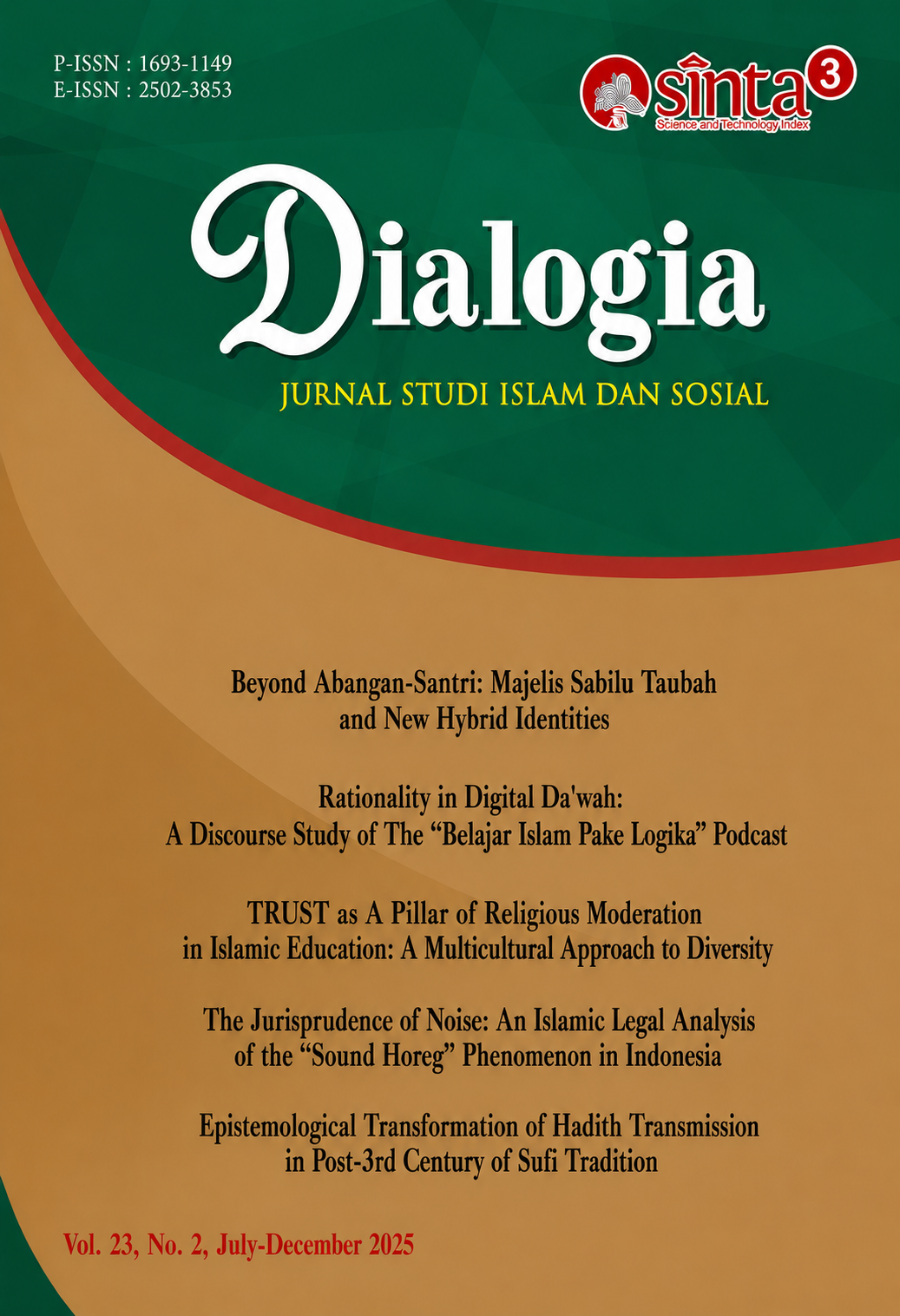
Epistemological Transformation of Hadith Transmission in Post-3rd Century of Sufi Tradition
DOI:
https://doi.org/10.21154/dialogia.v23i02.12096Abstract
The discourse on hadith transmission within the Sufi tradition presents a compelling subject for inquiry, particularly concerning its inherent dynamics and the intellectual tensions arising between Sufi practitioners and ḥadīth scholars. While Sufis define themselves as guardians of Prophetic teachings through spiritual realization and divine connection, a paradoxical divergence emerges: their methods of transmission often contravene the principles of validation recognized by mainstream scholarship. Departing from this apparent contradiction, this study investigates the epistemological framework through which Sufis engage with hadith and the methodological principles underpinning their transmission practices. Employing a descriptive-qualitative methodology in library research methodology, relevant data were systematically collected, verified for authenticity, classified thematically, and subjected to critical analysis and reflection. This inquiry reveals that the transformation within Sufi circles and the doctrine of taṣawwuf itself is fundamentally shaped by historical shifts, with each epoch developing distinct forms and modes of praxis. The principal finding of this research lies in the demonstration that the evolution of transmission practices follows a discernible trajectory: it originated within the traditional framework governed by the isnād system, transitioned into a phase marked by the simplification or truncation of isnāds, and culminated in the emergence of methods radically distinct from the established tradition of hadith scholars. This final stage is characterized by alternative methodologies based on kashf and ru’yā. The adoption of these alternative methods stems from the Sufi ambition to maintain a continuous spiritual connection with the Prophet, a connection they contend is accessible primarily through contemplative practice. While contemplation possesses a basis for legitimacy within Prophetic tradition, its application as a formal channel for transmitting ḥadīth risks replicating a historical peril: the proliferation of fabricated hadiths. This risk arises from the inherent difficulty of verifying the chain of transmission (isnād) and the matn of such experientially-received knowledge through the systematic criteria developed within the classical science of hadith.
REFERENCES
Al Anwari, Ahmad Ubaidillah Ma’sum. ‘Melacak Konstruksi Dasar ‘Adālah al-Rāwī Dalam Tradisi Sufi’. Tesis, UIN Sunan Kalijaga, 2025.
Al-’Imād, Ibn. Syażārah Al-Żahab Fi Akhbār Man Żahab. Vol. 10. Beirut: Dār Ibn Kaṡīr, n.d.
Al-Kalābażī, Muḥammad Ibn Isḥāq. Al-Ta’arruf Li Mażhab Ahl al-Taṣawwuf. Beirut: Dār al-Kutub al-’Ilmiyyah, 1993.
Al-Laknawi, Muḥammad ‘Abd al-Ḥayyi. Al-Ajwibah al-Fāḍilah Li al-As’ilah al-’Asyrah al-Kāmilah. 7th edn. Halb: Maktabah al-Maṭbū’āt al-Islāmiyyah, 2007.
al-Maqdisī. Ṣafwah Al-Taṣawwuf. Beirut: Dar al-Muntakhab al-’Araby, 1995.
Al-Raḥmahurmuzī, Al-Ḥasan Ibn Abd al-Raḥman. Al-Muḥaddiṡ al-Fāṣil Baina al-Rāwī Wa al-Wā’ī. Dār al-Fikr, 1984.
Al-Thusi, Abu Nashr al-Siraj. Kitab Al-Luma’ Fi al-Tashawwuf. Mesir: Dar al-Kutub al-Haditsah bi Mishr, 1960.
Anwari, Ahmad Ubaidillah Ma’sum Al. ‘Kajian Autentisitas Hadis Dalam Kitab Ihya’ ‘Ulumuddin: Perbandingan Metodologi Antara Ahl Al-Hadits Dan Ahl Al-Shufi’. Skripsi, UIN Sunan Kalijaga, 2022.
Arafat, Ahmad Tajuddin. ‘Interaksi Kaum Sufi Dengan Ahli Hadis: Melacak Akar Persinggungan Tasawuf Dan Hadis’. Journal of Islamic Studies and Humanities 2, no. 2 (2017).
———. ‘Mata Rantai Sufi Perawi Hadis Dalam Al-Kutub at-Tis’ah’. UIN Walisongo, 2017.
Arafat, Ahmad Tajuddin, Mutma’inah, and Hanik Rosyida. ‘Sufistic Approach in Understanding Hadith: Ḥakīm al-Tirmidhī’s Viewpoint’. Teosofia: Indonesian Journal of Islamic Mysticism 11, no. 1 (2022).
Aṣfihānī, Abū Nu’aim al-. Ḥilyah Al-Auliyā’ Wa Ṭabāqah al-Aṣfiyā’. Vol. 9. Dār al-Fikr, 1996.
Asqalani, Ibn Hajar al-’. Ta’rīf Ahl al-Taqdīs Bi Marātib al-Mauṣūfīn Bi al-Tadlīs. Madinah: Maktabah al-Manār, n.d.
Aṭṭār, Farid al-Dīn al-’. Tażkirah Al-Auliyā’. Translated by Muhammad al-Ashīly al-Wasṭānīy. Syuriah: Dār al-Maktabī, 2009.
Azami, Muhammad Mustafa. Hadis Nabawi Dan Sejarah Kodifikasinya. Translated by Ali Mustafa Ya’qub. Jakarta: Pustaka Firdaus, 2020.
Baghdādī, Al-Junaīd al-. Tāj Al-’Arifīn. Dār al-Syurūq, 2005.
Brown, Daniel W., ed. The Wiley Blackwell Concise Companion to The Hadith. UK: John Wiley & Sons Ltd, 2020.
Dickson, William Rory. ‘Sufism and Shari’a: Contextualizing Contemporary Sufi Expressions’. Religions 13, no. 449 (2022).
Ghazālī, Abū Ḥāmid al-. Iḥyā’ Ulūm al-Dīn. Beirut: Dār Ibn Hazm, 2005.
Hanbal, Ahmad Ibn. Al-Zuhd. Mesir: Dār al-Ghadd al-Jadīd, 2005.
Ibn al-Mubārak, Abdullāh. Al-Zuhd Wa al-Raqāiq. Riyadh: Dār al-Mi’rāj al-Dauliyyah, 1995.
Ibn ‘Arabī. Fuṣūṣ Al-Ḥikam. Beirut: Dār al-Kitāb al-’Arabī, n.d.
Idri. Problematika Autentisitas Hadis Nabi Dari Klasik Hingga Kontemporer. Jakarta: Kencana, 2020.
Khaṭīb, Muhammad ‘Ajjāj al-. Ushūl Al-Hadīṡ: ‘Ulūmuhu Wa Musthalahu. Mesir: Dār al-Fikr, 2006.
Kudhori, Muhammad. ‘Metode Kashf Dalam Penilaian Hadis: Studi Tashih Hadis Di Kalangan Kaum Sufi’. Jurnal Afkaruna 14, no. 1 (2018).
Makkī, Abī Thālib al-. Qūt Al-Qulūb. Dār al-Turāṡ, 2001.
Māliki, Muhammad Ibn ‘Alawi al-. Al-Qawā’id al-Asāsiyyah Fi ‘Ilmi Muṣṭalah al-Hadiṡ. 2002.
Mar’iy, Mu’min Jamal Abdul Aziz. ‘Al-Maqāmāt Wa al-Ahwāl ‘inda al-Shūfiyyah Wa Muwaqqifu al-Salaf Minha’. Thesis, Jāmi’ah al-Quds, 2021.
Muḥammad, Yūsuf Khaṭṭār. Al-Mausū’ah al-Yūsufiyyah Fi Bayāni Adillah al-Ṣūfiyyah. Dār al-Taqwā, 2003.
Muḥāsibī, Al-Ḥāriṡ al-. Risālah Al-Mustarsyidīn. Ḥalb: Dār al-Salām, 1983.
Muslim Ibn al-Hajjaj. Shahih Muslim. Dar al-Tashil, 2014.
Naisabūrī, Al-Hākim al-. Ma’rifah ‘Ulūm al-Hadīṡ Wa Kamiyyah Ajnāsih. Beirut: Dār Ibn Hazm, 2003.
Nasr, Sayyed Hossein. Islam: Religion, History, and Civilization. HarperCollins e-book, 2002.
Nitze, Richard. The Unconscious Mind and Problem Solving. Cambridge University Press, 2018.
Nurdin, Eep Sopwana. Pengantar Ilmu Tasawuf. Bandung: Aslan Grafika Solution, 2020.
Palmer, Aiyub. ‘Sufism’. In The Wiley Blackwell Concise Companion to the Hadith. UK: Wiley Publisher, 2020.
Qāsimī, Muḥammad Jamāl al-Dīn al-. Qawā’id al-Taḥdīṡ Min Funūn Muṣṭalaḥ al-Ḥadīṡ. Beirut: Muassasah al-Risālah, 2004.
Qusyairi, Abdul Karim al-. Risālah Al-Qusyairiyyah Fī ‘Ilm al-Taṣawwuf. Beirut: Dar al-Khayr, 2004.
al-Sya’rani, Abdul Wahhab. Al-Ṭabaqāh al-Kubrā. Beirut: Dar al-Fikr, 2006.
Simuh. Tasawuf Dan Perkembangannya Dalam Islam. Yogyakarta: IRCiSoD, 2019.
Subki, Tajuddin al-. Thabaqah Al-Syafi’iyyah al-Kubra. Dar Ihya’ al-Kutub al-’Arabiyyah, 1918.
Suriasumantri, Jujun. Filsafat Ilmu: Sebuah Pengantar Populer. Jakarta: Pustaka Sinar Harapan, 2005.
Suyūṭī, Jalāl al-Dīn al-. Tadrib Al-Rāwī Fī Syarḥ Taqrīb al-Nawāwī. Riyadh: Maktabah al-Kauṡar, 1994.
Tirmīżi, Al-Hakīm al-. Nawādir Al-Uṣūl Fī Ma’rifah Ahādīṡ al-Rasūl. Beirut: Dar al-Nawadir, 2010.
Tottoli, Roberto. ‘Genres’. In The Wiley Blackwell Concise Companion the Hadith, edited by Daniel W. Brown. UK: Wiley Publisher, 2020.
Weber, Max. Economy and Society: An Outline of Interpretative Sociology. University of California Press, 1978.
Zed, Mestika. Metode Penelitian Kepustakaan. Jakarta: Yayasan Pustaka Obor Indonesia, 2004.
Zuhar, ‘Adnan ‘Abdullah. Taṣḥīḥ Al-Ḥadīṡ ‘inda Sādah al-Ṣūfiyyah. n.d.
Downloads
Downloads
Published
Issue
Section
License
Copyright (c) 2025 Ahmad Ubaidillah Ma'sum Al Anwari, Muhammad Akmaluddin

This work is licensed under a Creative Commons Attribution-NonCommercial-ShareAlike 4.0 International License.
Dialogia : Jurnal Studi Islam dan Sosial allow the author(s) to hold the copyright without restrictions and allow the author(s) to retain publishing rights without restrictions, also the owner of the commercial rights to the article is the author.