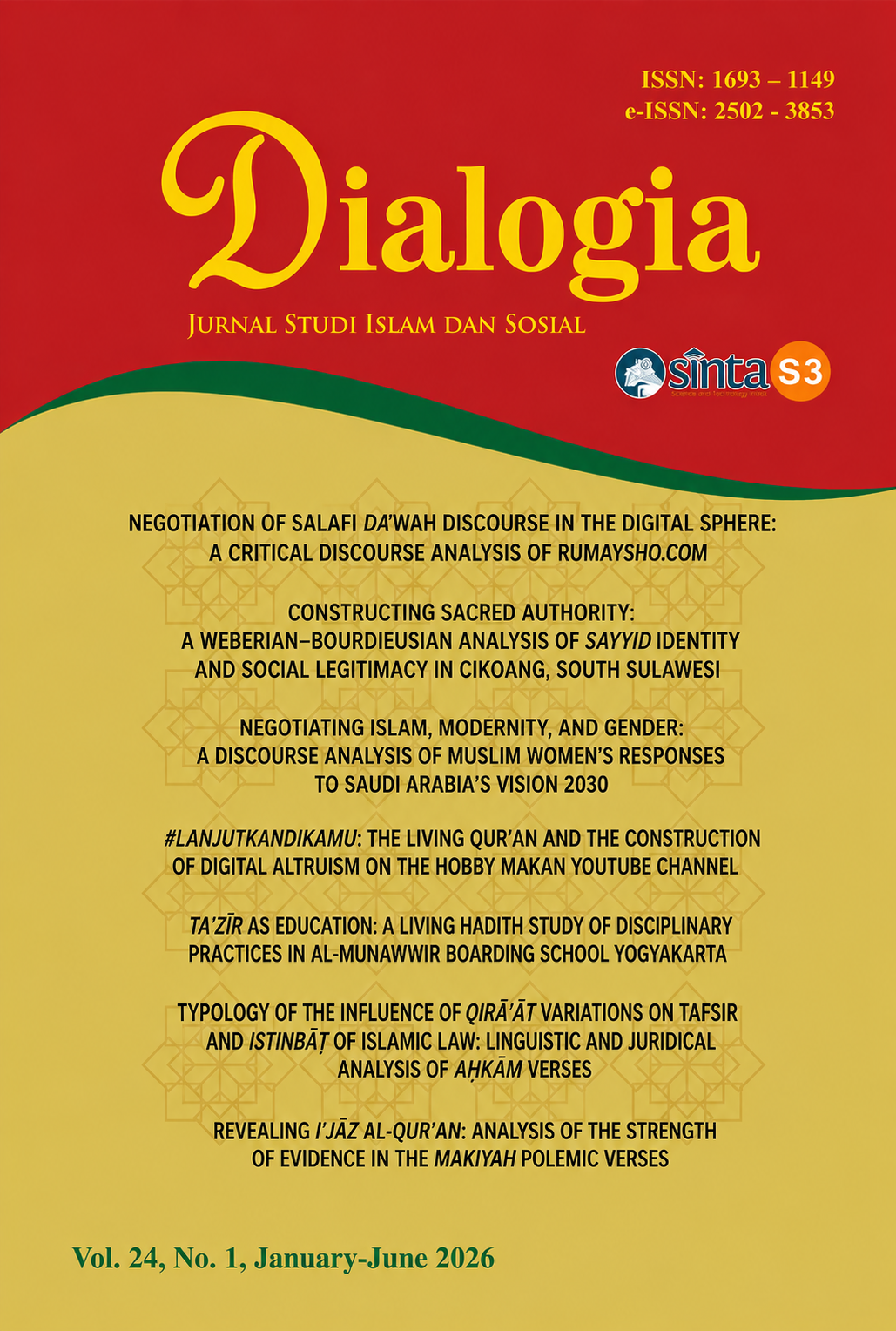
Negotiating Islam, Modernity, and Gender
A Discourse Analysis of Muslim Women’s Responses to Saudi Arabia's Vision 2030
DOI:
https://doi.org/10.21154/dialogia.v24i01.12277Kata Kunci:
Vision 2030, Saudi Muslim Women, Social Reform, Islamic Feminism, Discourse AnalysisAbstrak
Gerakan reformasi sosial yang diluncurkan melalui Vision 2030 di Arab Saudi menandai fase baru modernitas Islam dengan menempatkan pemberdayaan perempuan sebagai pilar utama transformasi nasional. Penelitian ini bertujuan untuk menelaah respons perempuan Muslim terhadap reformasi tersebut dan menganalisis bagaimana wacana Islam kontemporer merekonstruksi makna peran perempuan dalam kerangka peradaban Islam modern. Dengan pendekatan deskriptif-kritis, penelitian ini menggunakan metode studi kepustakaan melalui analisis wacana Foucault yang dipadukan dengan perspektif feminisme Islam Amina Wadud. Data diperoleh dari dokumen resmi Vision 2030, laporan lembaga internasional, publikasi akademik, dan percakapan media sosial (Twitter/X) yang merepresentasikan pandangan perempuan Saudi. Hasil penelitian menunjukkan tiga pola respons utama: adaptif, resistif, dan ambivalen. Selain itu, negara menggunakan Islam sebagai instrumen ideologis melalui tiga tahap wacana; legitimasi keagamaan oleh otoritas ulama, reinterpretasi ajaran Islam dalam forum keagamaan global, dan internalisasi nilai Islam moderat dalam kebijakan sosial. Penelitian ini menyimpulkan bahwa reformasi Vision 2030 tidak hanya mengubah kebijakan gender, tetapi juga merekontekstualisasi wacana Islam yang menempatkan perempuan sebagai subjek aktif dalam negosiasi antara agama, budaya, dan modernitas.
Kata Kunci: Vision 2030, Perempuan Muslim Saudi, Reformasi Sosial, Feminisme Islam, Analisis Wacana.
Unduhan
Referensi
Ainurrofiq, Faiq, and Nurul Khasanah. “From Domestic to Public: The Construction of Women’s Empowerment Discourse In Saudi Arabia’s Vision 2030.” Akademika : Jurnal Pemikiran Islam 29, no. 1 (2024): 101. https://doi.org/10.32332/akademika.v29i1.7755.
Alhawsawi, Sajjadllah, and Sabria Salama Jawhar. “Education, Employment, and Empowerment among Saudi Women.” Gender and Education 35, no. 4 (2023): 401–19. https://doi.org/10.1080/09540253.2023.2189917.
Alhokail, Loujayn. “The Inclusion of Women in the Labour Market: Saudi Arabia’s Leap from 21.2 % to 35.5 % and Beyond.” World Journal of Women and Sustainable Development 1, no. 1 (2025): 15. https://doi.org/10.47556/J.WJWSD.1.1.2025.3.
Almutairi, Najla Tharman. “Does Oil Wealth Matter to Female Labour Force Participation: New Evidence from the Oil-Intensive Economy of Saudi Arabia.” Resources Policy 78 (September 2022): 102797. https://doi.org/10.1016/j.resourpol.2022.102797.
Al-Rasheed, Madawi. The Son King: Reform and Repression in Saudi Arabia. Oxford University Press, 2021. https://doi.org/10.1093/oso/9780197558140.001.0001.
Arabia, Kingdom of Saudi. Vision 2030 Annual Report 2024. Kingdom of Saudi Arabia, 2024. https://www.vision2030.gov.sa/media/25042025ev1/En-Annual%20Report-Vision2030-2024.pdf.
Armila, Nizma, and Mega Satria Nurul Falah. “Negotiating Text and Context: The Hadith on the Prohibition of Women’s Travel Without a Maḥram in the Social and Legal Histories of Saudi Arabia and Indonesia.” Al Qalam: Jurnal Ilmiah Keagamaan Dan Kemasyarakatan 20, no. 1 (2026): 131. https://doi.org/10.35931/aq.v20i1.5883.
Barlas, Asma. Believing Women in Islam: Unreading Patriarchal Interpretations of the Qur’ān. Revised edition. University of Texas Press, 2019.
Burg, Niencke Van. “Gender Reforms in Saudi Vision 2030: FreedomVs Equality.” Leiden Student Journal of Humanities, 2024. http://thenewscholar.nl.
Creswell, John W., and Cheryl N. Poth. Qualitative Inquiry & Research Design : Choosing among Five Approaches. SAGE Publications, 2018.
Foley, Sean. “Legitimizing Transformation without Calling It Change: Tajdīd, Iṣlāḥ , and Saudi Arabia’s Place in the Contemporary World.” Contemporary Review of the Middle East 2, nos. 1–2 (2015): 55–70. https://doi.org/10.1177/2347798915577717.
Foucault, Michel. Archaeology of Knowledge. Taylor and Francis, 2013.
Hassan, A. “Modern Islam and Social Harmony: The Ideological Foundation of Saudi Vision 2030.” Journal of Islamic Civilization Studies 15, no. 2 (2023): 98–115.
Latifah, Ainiyatul, and Ade Solihat. “Power Relation and Knowledge: Linking Islamic Education to Socio-Political Reform in Saudi Arabia.” ATTARBIYAH: Journal of Islamic Culture and Education 9, no. 2 (2024): 157–72. https://doi.org/10.18326/attarbiyah.v9i2.157-172.
Mahdavi, Pardis. Gendered Citizenship and Social Change in the Gulf. Stanford University Press, 2020.
Ministry of Islamic Affairs. “وزير الشؤون الإسلامية: حقوق المرأة في المملكة أصبحت نموذجًا مشرفًا.” 2024. https://www.moia.gov.sa/MediaCenter/News/Pages/21021446_9.aspx.News, Arab. “35,000 Saudi Women Studying Abroad on Government Scholarship.” 2017. https://www.arabnews.com/node/1082551/amp.
News, Arab. “Saudi Arabia’s Surge in Female Workforce Participation Drives Economic Impact.” August 2024. https://www.arabnews.com/node/2567745/business-economy.
Ni’ami, Mohammad Fauzan, Dio Alif Bawazier, and Sukron Ma’mun. “MODERNIZATION, ECLECTICISM, AND SAUDI ARABIA VISION 2030 ON FAMILY LAW: Positivization of Talaq Divorce in Niẓam Al-Aḥwāl 1443 H.” Al-Ahwal: Jurnal Hukum Keluarga Islam 16, no. 1 (2023): 1–22. https://doi.org/10.14421/ahwal.2023.16101.
Organization (ILO), International Labour. Labor Force Participation Rate, Female (% of Female Population Ages 15+) (Modeled ILO Estimate). ILOSTAT, International Labour Organization, 2025. https://data.worldbank.org/indicator/SL.TLF.CACT.FE.ZS.
Sirri, Lana. “From Theory to Action: A Saudi Arabian Case Study of Feminist Academic Activism against State Oppression.” Societies 14, no. 3 (2024): 31. https://doi.org/10.3390/soc14030031.
Statistics, Saudi General Authority for. Methodology of Labor Market Statistics 2024. Saudi General Authority for Statistics (GASTAT), 2024.
Sugiyono. Metode Penelitian Kuantitatif, Kualitatif, Dan R&D . Alfabeta, 2020.
“The Gulf Entrepreneur | Inspiring Middle East Business Success.” n.d. https://thegulfentrepreneur.com/.
Wadud, Amina. Inside the Gender Jihad: Women’s Reform in Islam. Oneworld, 2006.
Wadud, Amina. Qurʼan and Woman : Rereading the Sacred Text from a Woman’s Perspective. Oxford University Press, 1999.
Zada, Khamami, Afwan Faizin, Akhmad Mughzi Abdillah, Ahmad Hifni, and Johan Wahyudi. “The Constitutionalization of Sharia in Muslim Countries: Historical and Political Struggles in Indonesia, Türkiye, and Saudi Arabia.” Mazahib 24, no. 2 (2025): 435–55. https://doi.org/10.21093/mj.v24i2.11679.
Zilfa, Rohil. “Telaah Komparatif Pengarusutamaan Gender Dalam Pendidikan Islam Di Saudi Arabia, Mesir, Malaysia, Dan Indonesia.” Jurnal Pendidikan Agama Islam (Journal of Islamic Education Studies) 5, no. 2 (2017): 264. https://doi.org/10.15642/jpai.2017.5.2.264-287.
عبد الله قبـــوري, عفــاف. “تمكين المرأة في المجالات التنموية في ضوء رؤية 2030 Empowering women in development fields in the light of Vision 2030.” المجلة العلمية لعلوم التربية النوعية 13, no. 13 (2021): 106–30. https://doi.org/10.21608/sjsep.2021.343719.
Unduhan
Diterbitkan
Terbitan
Bagian
Lisensi
Hak Cipta (c) 2026 Nadia Arrifqi, Wardah Nailah El-Izzah Atulolon, Amanda Putri, Nabila Izzatul Ufairah, Ahmad Kholil

Artikel ini berlisensiCreative Commons Attribution-NonCommercial-ShareAlike 4.0 International License.
Dialogia : Jurnal Studi Islam dan Sosial allow the author(s) to hold the copyright without restrictions and allow the author(s) to retain publishing rights without restrictions, also the owner of the commercial rights to the article is the author.